Modeling the Storm: Inside the Sustainable Urban Systems Lab
By Melissa Alonso | October 2025 - Atlanta, GA
In the School of Architecture’s Sustainable Urban Systems Lab (SUSLab), led by Assistant Professor Patrick Kastner, weather events like hurricanes aren’t simulated as disasters—they’re studied as data. Kastner’s lab explores how cities can endure the unpredictable through microclimate modeling, energy simulation, and resilient design education.
“We don’t model hurricanes directly,” Kastner explains, “but we model the conditions they leave behind—extreme heat, flooding, outages, and system failures. Our goal is to help decision-makers design for resilience before it’s too late.”
Simulating the unthinkable
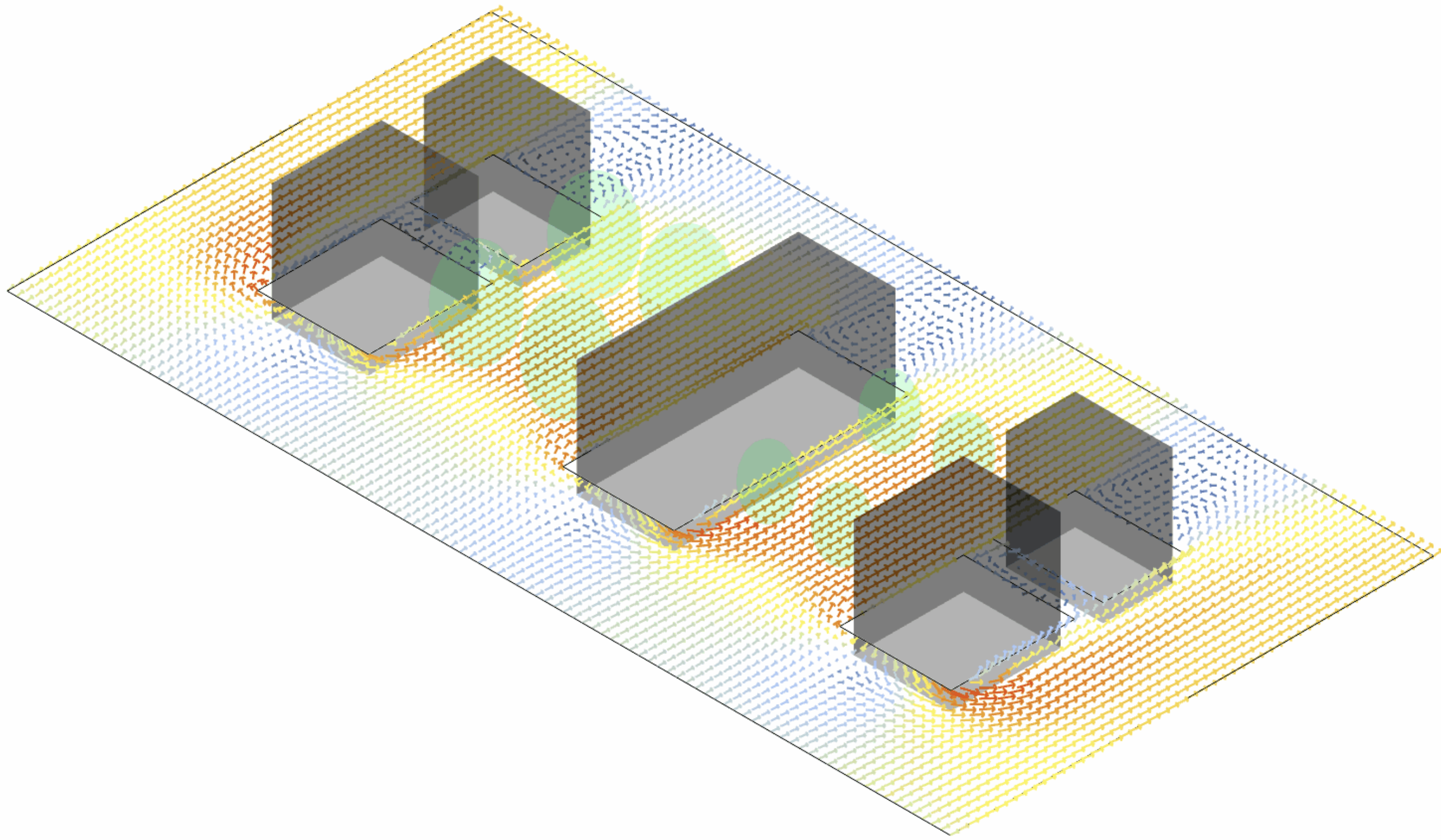
Kastner’s team uses computational tools like Eddy3D—a microclimate modeling toolkit he developed during his Ph.D. at Cornell—to simulate how urban form influences climate conditions. “When you design a building or a street,” he says, “you’re not just shaping a skyline—you’re shaping the air people breathe and the temperatures they feel.”
His students run simulations that test the ripple effects of design choices: how street width channels wind, how façades trap or reflect heat, how vegetation mitigates temperature swings. “These are small design decisions that add up to major resilience outcomes,” he notes.
What happens when the power goes out
Kastner’s lab also studies energy modeling in extreme-weather scenarios—especially when systems fail. “After a hurricane, power can be out for days,” he says. “So we ask: how long can a building stay habitable without AC? Can we design for passive comfort?”
When Georgia Tech faced a real-world test—a campus cooling failure that closed buildings for nearly three weeks—Kastner’s team used the event as a case study. “It showed us how dependent we are on mechanical systems,” he says. “Good design should keep people safe even when the power goes off.”
Design education for the climate generation
For Kastner, resilience isn’t just research—it’s pedagogy. His Data-Driven Methods for Design and Sustainability seminar invites Ph.D. and master’s students to merge computation with creative thinking. One student’s recent project explored modular construction for wildfire response—structures that could be rapidly deployed, disassembled, and reused. “It’s that kind of agility we’ll need as climate disasters intensify,” Kastner says.
He’s also watching the rise of machine learning in environmental modeling. “Machine learning will make forecasting faster and more accurate,” he explains. “You’ll be able to simulate an entire city’s weather patterns in real time—and design accordingly.”
“At the end of the day,” Kastner says, “our work is about giving designers and planners the tools to make better decisions. Extreme weather isn’t going away—but good design can make surviving it a lot more likely.”
Questions?
Contact Us