Master of Architecture Student Maria Pastorelli presents her final review presentation to faculty and visiting critics.

Master of Architecture

Master of Architecture

The M.Arch is a STEM-designated professional practice program of architecture that leads to licensure in architecture. Fully accredited by the National Architectural Accrediting Board (NAAB), this degree option provides flexibility for students who have an undergraduate degree with a major in architecture as well as those with a degree in a field other than architecture. The M.Arch. Program requires a minimum of 60 credit hours and a maximum of 102 credit hours of study, full-time and in-person, depending upon the applicant's prior education in architecture and the amount of advanced standing credit granted upon admission to the program. Please note: Successful completion of the Master of Architecture requires a minimum grade of C in all courses. Advanced standing credit is only granted for courses in which the student received a grade of A or B.

Normally, a student admitted to the program with maximum advanced standing can expect to complete the program within two academic years (4 semesters) of full-time study. A student admitted to the program with no advanced standing can expect the program to require three years (7 semesters) of full-time study. Graduates from four-year undergraduate programs in architecture similar to that at Georgia Tech can normally expect to complete the program in two academic years, provided they have pursued architecturally related elective coursework during their undergraduate years. Specific information regarding applications for advanced standing and degree requirements is available from the School of Architecture.

Multidisciplinary studies are strongly encouraged in all of the master's programs in architecture. These studies may be part of a formal dual degree program, including architecture and city and regional planning. Other multidisciplinary studies are possible within the College of Design, the Institute, or at other Atlanta area colleges and universities, such as Emory University and Georgia State University. Coursework outside the School of Architecture frequently includes city and regional planning, public policy, history, philosophy, real estate development, engineering, and studio art.

2024 Graduate Virtual Open House

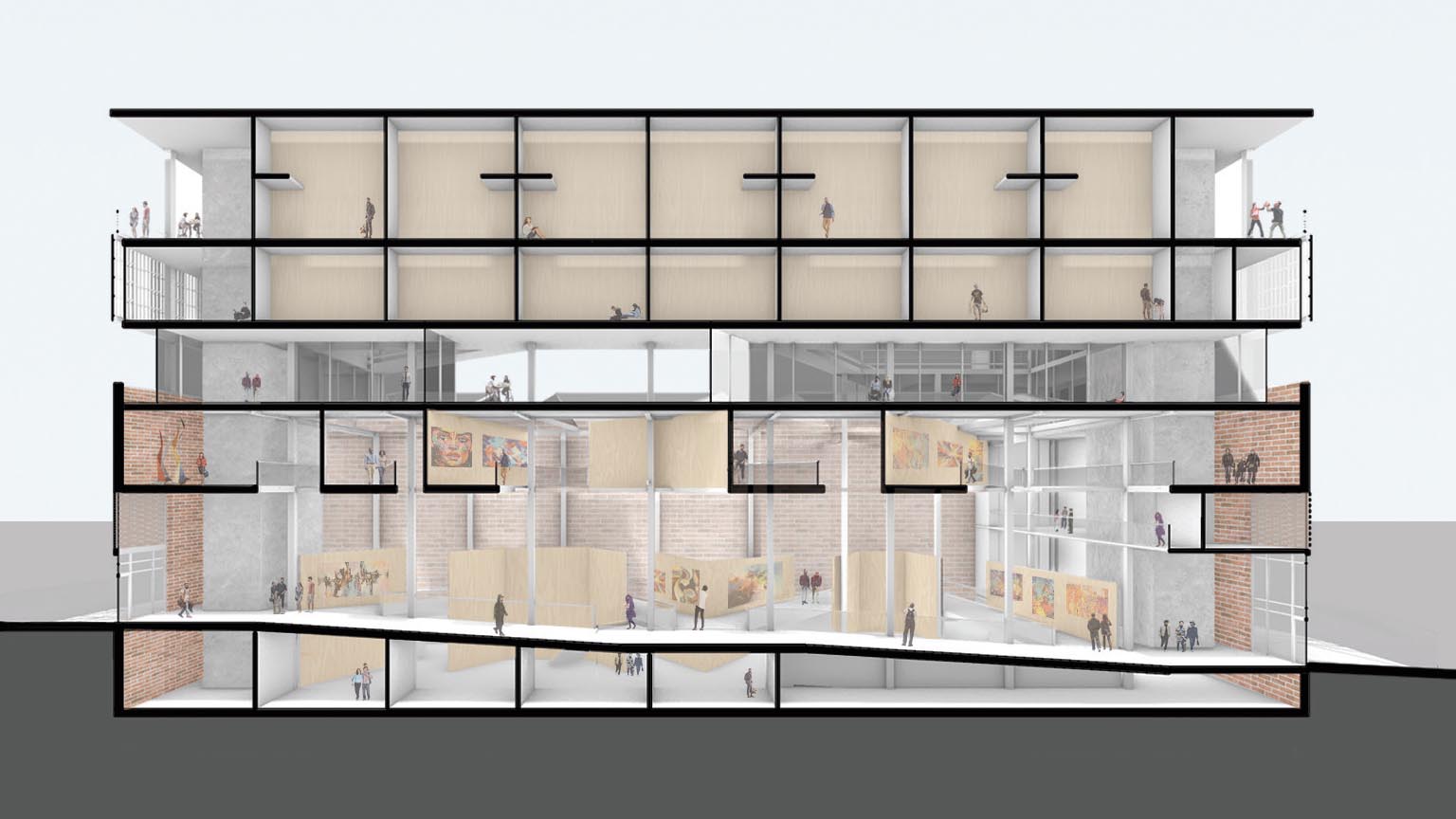
Section perspective showing how floor cuts work to form the gallery walkways and how those are always visually connected to the ground and basement floors. It also highlights the co-working floor, which has an inset glass façade that allows the co-living floors to conceptually float above the existing brick building.

Our Program

Featured Work: Section Prospective by Portman Prize Winner, Carly Langsdorf

Our students have the opportunity to pursue their interests in a range of topics including sustainability, urbanism, material and building systems, digital design & fabrication, high performance buildings, design & health, and others. Acknowledging the transformative changes occurring in the profession of architecture, our program anticipates what practice will be in the near future and prepares our graduates to be in front of - and leaders of - these changes.

M.Arch Tracks

You do not need an undergraduate architecture degree to enroll in our M.Arch program. We actively recruit and accept graduate students with diverse degrees including humanities, engineering, business, and social and natural sciences. Applicants come from a wide range of universities throughout the United States and abroad and one of the strengths of our program is the cultural and intellectual diversity of our students. 

M.Arch Student, Alex Knight, observes how his model responds to light for Keith Kaseman's Fall 2018 studio.

3-Year M.Arch

Those with an undergraduate degree in a non-architecture discipline can apply to the 3 year M.Arch.
Associate professor, Michael Gamble, works with students during his Fall 2018 studio.

2-Year M.Arch

Those with a four-year preprofessional degree in architecture can apply for the 2 year M.Arch.

Your Path to Architectural Licensure

Licensure requirements in the United States reside at the state level, and typically include an accredited professional degree, a period of practical training, and successful completion of all of the sections of the Architect Registration Examination (ARE).  Each state determines the specific requirements with regard to education, initial training, examination, and professional practice.  Alternate pathways are also available depending on the state of application.  To learn more, visit the National Council of Architectural Registration Boards below.

Connect with an Ambassador

Our Graduate Ambassadors are faculty-nominated student representatives who embody the diversity, talent, and enthusiasm of our School. Our ambassadors are available to answer questions about our school and share their experiences as architecture students at Georgia Tech.

Questions?

 
If you can't find the information you were looking for, we'll get you to the right place.
Contact Us