By Ann Hoevel | Sept 21, 2026 – Atlanta, Georgia
Simin Nasiri, who earned her Master of Science in Architecture at Georgia Tech and is now pursuing a Ph.D. in cognitive psychology and neuroscience in the School of Psychology, wanted to know how a building could be memorable.
Her curiosity built a space that connected architects and neuroscientists and pushed both disciplines forward.
"I started this project with Sonit Bafna when I was doing my Master’s of Science in Architecture. We were interested in how curiosity impacts our spatial memory and cognitive mapping,” Nasiri said.
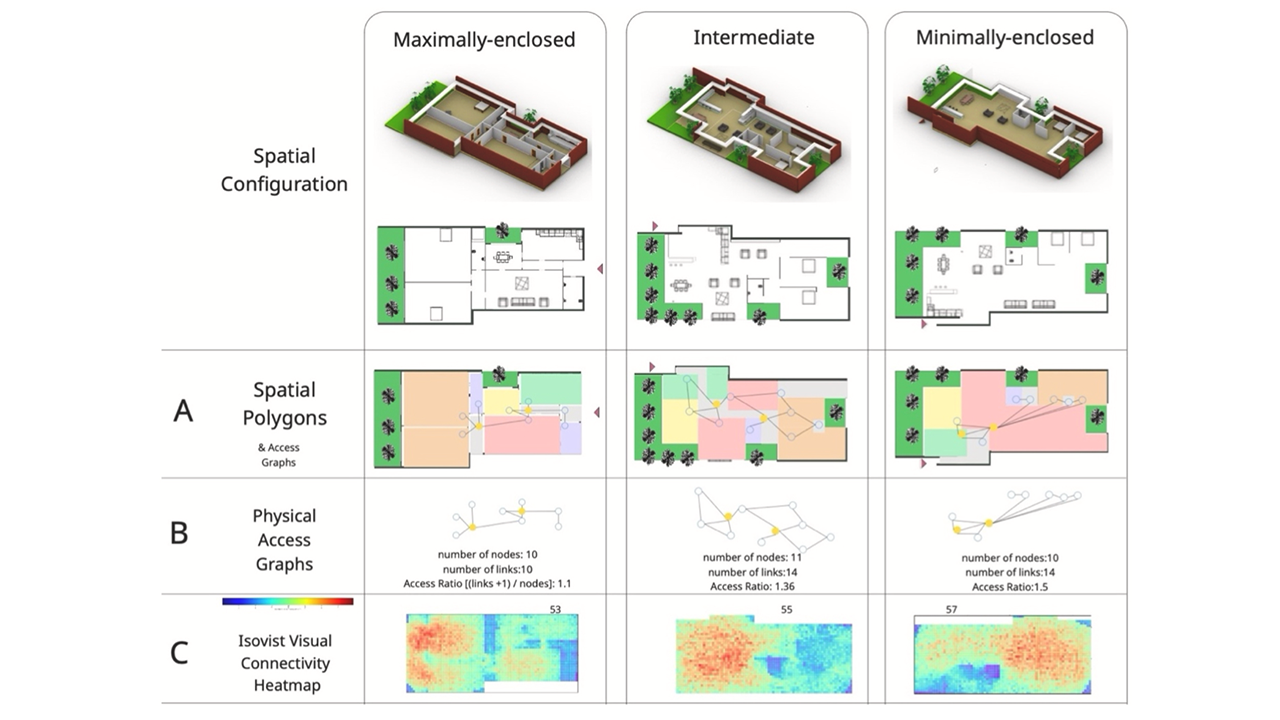
Nasiri’s master's thesis studied the ways fully open, fully enclosed, and semi-open floor plans affected curiosity, exploration, and spatial memory in participants using virtual reality environments and eye-tracking technology.
Next, she applied rigorous neuroscience methodology, including fNIRS brain imaging to measure neural activity, to the foundational study of her master’s thesis. Her Ph.D. advisor, Associate Professor in the School of Psychology Thackery Brown, is best known for his expertise in spatial memory, the hippocampus, and cognitive mapping.
The result is a paper published in Neuropsychologia this summer, titled “The Architecture of Curiosity: How Spatial Configuration Influences Affect, Exploration, and Memory.”
Two Fields, One New Direction
The distance between architecture and neuroscience was not accidental, said Bafna, professor and director of the M.S.Arch and Ph.D. programs in the School of Architecture.
"Architects who talk about things like aesthetics and cultural meaning have been concerned that science could explain away their design choices, erasing the mystery and depth of architecture. In the 1980s and 1990s the postmodern movement saw the rise of an anti-science feeling. But over the last ten, twenty years, that has relaxed. Architects are getting much more interest in science now,” Bafna said.
Neuroscience had its own blind spot, Brown said, explaining that the tradition in brain research had been to study space by stripping it down. "Keep it as simple as possible," he said. "Let's have a box. Let's have a rat or a person run around in this little box, and we'll measure how the neurons react."
In a plain rectangular room, neurons fire in a clean, grid-like pattern. It looks elegant, Brown said. But add a wall or any complexity at all, and those neural responses change dramatically.
"If we only study spatial memory in a simple environment," Brown said, "we're actually not learning as much as we thought about how the brain helps us navigate a more complex space like even your home."
"The experimental designs and the architectural designs are converging," he said. "These fields are literally coming together right now."
The Curious Puzzle of the Open Plan
Open floor plans became dominant in residential and workplace design despite being, in many practical respects, inferior to traditional layouts, Bafna said. They are noisier, offer less privacy, and use space less efficiently. Yet people consistently prefer them.
Architects who inherently disagreed with the function of open concept designs somehow felt that “it produces a quality that makes you feel better, that makes you feel more involved, more interested,” Bafna said. “But nobody has ever tested this before."
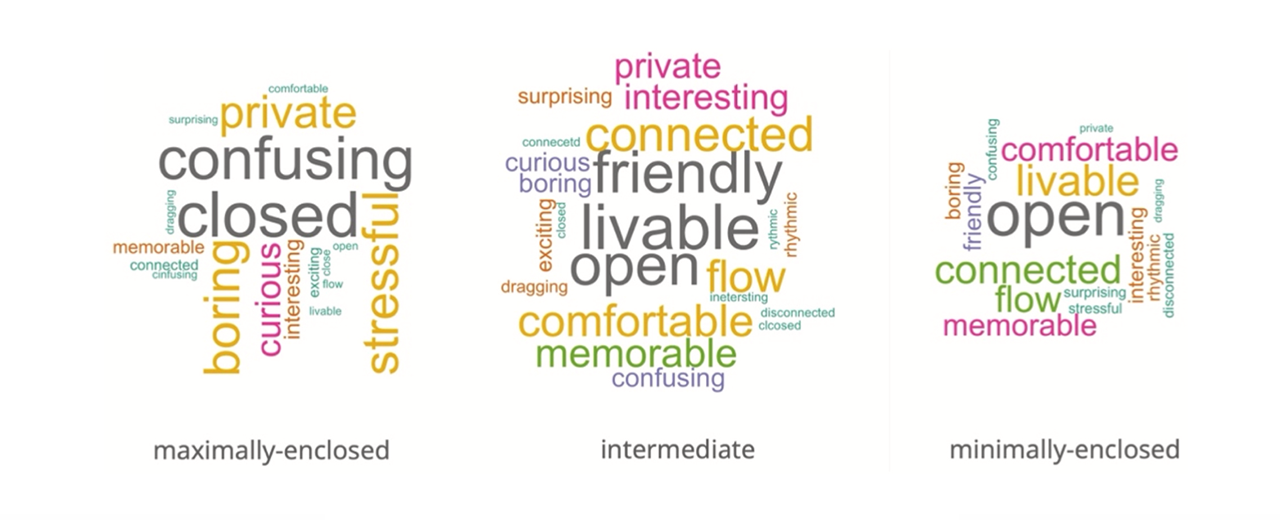
Nasiri, Bafna, and Brown compared three types of environments: fully open spaces, fully enclosed spaces, and spaces with an intermediate level of openness. Participants were not given tasks. They were simply invited to explore.
Neither extreme performed best. "In the open environment, they found it dull," Nasiri said. In the fully enclosed spaces, participants felt confused and lost.
In the semi-open environments, people moved more, covered more ground, and reported feeling significantly better. The memory findings were equally striking: participants who explored the semi-open environments demonstrated stronger spatial memory afterward.
Brown explained why from the neuroscience side: “A fully open space is easy for the brain to process but offers little to organize around. A fully enclosed space provides structure but demands too much cognitive effort. The intermediate space does both,” he said.
"An intuition that architects had that semi-open spaces look good suddenly turns out to have both behavioral and health consequences as well,” Bafna added.
The reason lies in curiosity itself, Nasiri said. "Curiosity is our brain's reward system. When we get curious about something, our brain rewards us with the information, and we learn."
The implications extend across nearly every environment people inhabit, including workplaces, schools, museums, and cities. The stakes feel highest in spaces designed for aging populations. The instinct is often to simplify, to remove complexity in the hope of reducing disorientation. Brown argued that instinct may be exactly wrong.
"It won't be stimulating to them. They won't be moving around. They won't be curious about this space. And we know that when you move someone into a care facility and it is a white box, their cognition declines really rapidly," he said.
"If we lose curiosity," Nasiri said, "I think we'll lose everything."